Monday, 22 October 2012

Wille style axe handle....

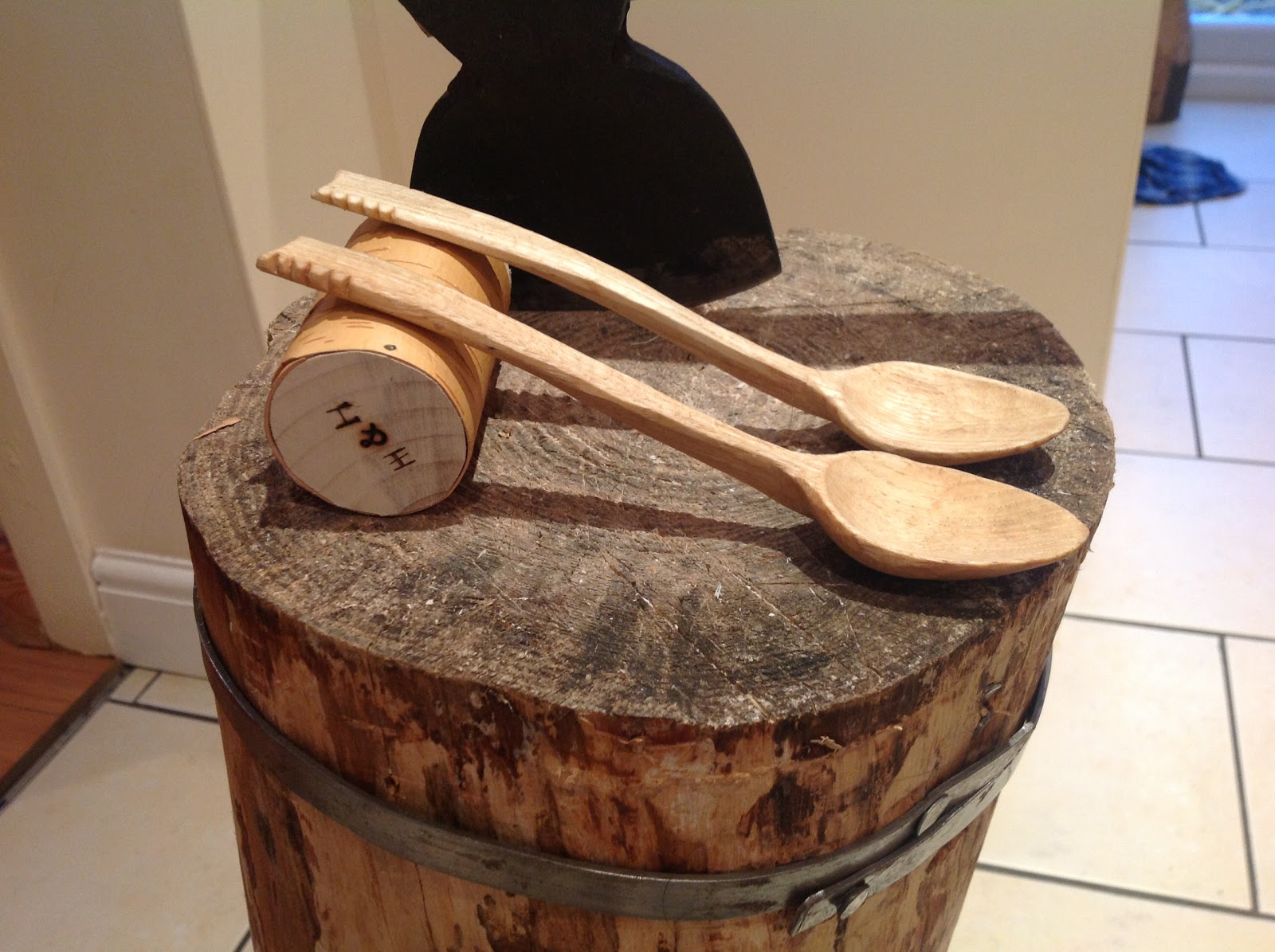
As I have said before, I love my little Kent pattern axe. It is just the right size and weight for me for spoon carving, it holds an edge well and it was free - the best kind! You may have seen my previous post about re-handling my axe? Well, after seeing some of the axes at Spoonfest I decided to try over. Not that I was unhappy with my first attempt, though the socket of the axe was a little longer than the width of the wood I was using and there was a little bit of tear-out on the swell at the end of the handle. I was happy with it, overall - until I saw the classic Gransfors carving axe which, I was confidently informed, sports a handle originally designed by, surprise, surprise, Wille Sundqvist. Here is a picture for those of you who have never seen it - I'm lead to believe you can't buy them like this any more.

It is a really nice rustic, angular styled handle with long cuts all the way up the length of the handle.

Having been given some nice straight pieces of ash, I thought I 'd have a go.
My previous handle (on the axe) and a template for the new one - good old cereal boxes.

cut roughly on the band saw

after cleaning up, putting in some of those nice long angular cuts

shaping the swell - mine's square in cross section while the originals look more eliptical

use your imagination - squint a little - looks alright, doesn't it?
The results seem fine on first inspection. Looks okay which, if I'm honest, was the main brief for this piece. As a bonus, it feels good in the hand too, though it might be completely different with the head on.

Julian tells me I'm too impatient and has forbidden me fitting the handle until it has has a chance to dry and shrink thoroughly, so for now I have to suffice with the picture above. I'll post a finished picture when I finally fit the head.

A few more spoons....

I feel a little self-conscious when I put up yet another post about yet more spoons as, to your average Joe, once you've seen one hand carved wooden spoon, to be quite honest, you've already seen one too many. I reasure myself, however, that for people of a like mind to me, you just can't get enough. It doesn't matter how many Robin or Sean or Steve or Alastair spoons I've previously seen, I still love looking at new ones. I'm hoping that the same applies here.

I've noticed when looking at others' blogs that, much like me, those who attended Spoonfest were particularly taken by Jarrod Stonedhal - both the man himself who, to put it simply, anyone would be thrilled to have as a neighbour, and his beautifully delicate and carefully rustic spoons. It's no coincidence that since Jarrods's spoons became more public, there's been a proliforation of painted spoons and tableware, not that he has a monopoly on paint, but he does it very well - I've yet to see any that hold a light to his.

The truth is, his were the only spoons I really wanted to buy a sample of from Spoonfest and, ironically, the first to sell out, hence I didn't get one and I mourned the fact for a couple of weeks after. Julian did get one, however, which I was very glad to have a go at copying.
Julian's Jarrod spoon - just perfect
As pointed out by Sean Hellman - cranked profile

My first attempts were in ash, and I was fairly pleased with the results.

 
Then I did one out of some very green rhododendron. I'd not used this wood before and it was a pleasure to carve - not unlike peeling potatoes, though because of the wood's softness, it didn't chip carve cleanly - probably should have let it dry out first.
 

Liking the design, yesterday I had a go with some curly grained ash, but this time a larger serving spoon.


I must apologise for the poor quality of the photos - it's just ipad quality as the lense on my Olympus PEN is broken and I can't bring myself to spend the money it will cost to repair or replace it.

Whilst I'm apologising, I should say something about the odd and fairly random layout of my posts - I HATE BLOGGER! It is the most unpredicatable software I think I have ever used. It is often impossible to do the simplest things. Come on Blogger developers, do something about it!


Tuesday, 2 October 2012

Axe File No:2 Cegga Axe

Quite a few years ago this axe came up as a group buy on the Bushcraft UK forum. It was made by Cegga, a Swedish blacksmith who works for Hultafors, but also does his own Cegga brand axes. It was co-designed by a fine Gentleman over on the Bushcraft UK known as British Red and I think the axe is called the Red Hunter's axe. It is 15" in length and the edge is just under 3" (sorry I can't do accurate fractions as I can only find my son's Early Learning Centre tape measure). It weighs less than 600g and for this reason is my first choice when travelling light. It was also an amazing bargain (£45 if I recall correctly).


The workmanship on this axe is amazing. It came razor sharp and really sings in use. I have used it for firewood preparation and carving, but I've no doubt you could fell and limb a tree with it if you had to. The polished head is supposed to make it more efficient, reducing friction as it passes through the wood. Having said that, It's very hard to tell how much difference it makes as I guess you would have to have an unpolished version to compare it to. My personal preference is for an unpolished axe, as I find that a forge finish resists rust better and if I'm honest i prefer the look.


I would definitely recommend a Cegga axe, if you can get hold of one. I would love to try one of his Viking style axes or even better, get him to make a custom carving axe, but he is not the easiest person to get in touch with. He doesn't have a website that I'm aware of and i sent him a message on Bushcraft UK several months ago, but never heard back from him. However I did see him post on Bushcraft UK recently and he even mentioned the possibility of a trip to the UK with some axes for sale. This is the kind of thing I would like to try.


 He also works in Damascus steel. Not my cup of tea, but i appreciate the workmanship.


Friday, 28 September 2012

Wille Sundqvist spoon?...Ummm...No....

In a workshop at Spoonfest Steve Tomlin said that one of the best ways to improve your spoon carving is to copy someone elses. I began to implement his advice this week by copying a rather nice Robin Wood serving spoon. I used ash and was quite pleased with the results.

Then, when Ju called me up to inform me he'd managed to buy a copy of Wille Sunqvist's famous 'Swedish Carving Techniques' I remembered that I'd taken a picture of a page of Robin Wood's copy while at Spoonfest so thought I'd have a go at copying one of his spoons - not the same as actually having a spoon in my hand, but I'd give it a go.
The famous Sundqvist spoon
The Bible of spoon carving


Here's a step by step pictorial of how I got on:
A cardborad template, drawn onto a piece of ash.


Roughing out with the axe

A concealed not meant a lot of tear-out - I probably should have discarded the wood and started again
but woods at a premium.

Close carving with the axe

Cleaned up with the knife - bowl marked on

Bowl hollowed out
Sanded and oiled

Design drawn on in pencil
Carved and rubbed with cinamon - I'd like the spoon a little darker in colour and the design a little lighter - perhaps age will sort that out for me?


Not quite as good as Wille's (ok, nowhere near as good) but a fair first attempt, I thought.

To sand or not to sand....

When earlier this year a tornado tore unexpectedly across Leicestershire it pulled up or otherwise demolished a number of trees in a number of villages. One such village was Newtown Linford where some rather old trees in and around Bradgate Park (where the ill-fated Lady Jane Grey had lived before reigning for only 9 days and then loosing her head) were up-rooted and a friend from work, thinking to stockpile timber for his woodburning stove, took out his chainsaw and set about cutting them up. To cut a long story short, he brought me in a few sections of ash, which was very welcome as I had recently been bemoaning the fact that I had nothing to carve.

When I split a couple of these ash rounds I noticed that one had an unusual grain formation whereby, instead of the grain running striaght, it was in tiny waves. I decided to make a couple of spoons in the hope that I could show off this incredible wavy grain pattern.

I know this is not a very clear picture - I'd hoped to be able to show the wavy grain pattern - but you can see the rippling undulations on the right of the wood from where it split.

Any way, I drew a simple desert spoon shape on the wood, unsure whether I'd even be able to carve it as it broke along the grain really easily. I was actually quite pleased with the spoon, but there was no real sign of the grain pattern, so I decided to sand and polish it to see if that brought it out.

Ordinarily, I don't sand. On a knife handle, yes, but on a spoon I like to leave the tool marks as a sign that it's hand made. And now I think I may have been seduced to the dark side, because I actually really liked the finished result, grain pattern aside.
After first sanding - the spoon picked up
a little pink colouring from a paper napkin
I used to apply the oil.


With the addition of a little chip caving


I made a second spoon, in much the same style, but after looking at some spoons on Peter Follansbee's site, wanted to try a technique where a 45 degree bevel is cut on the outside of the spoon bowl that then follows around and up the handle - simple but very attractive, I thought. Again, I was quite pleased with the result. And, of course, I sanded this one too.
Not terribly clear, but you can just make out that bevel
round the edge of the bowl and extending up to my thumb

Sunday, 16 September 2012

Junior spoon carvers...

My 8 year old Jude loves to whittle and he has often sat by the fire pit with me, using one of my knives, and whittled a stick down to a tooth pick, for no other purpose than the joy of whittling.

When a friend called to ask if their 9 year old Joe could come and play, as he had previously shown an interest in my knives and tools, I thought it would be a great opportunity to begin laying the ground work for a new generation of spoon carvers.

Having hewn a couple of pieces of green ash (see previous post - I know birch would have been easier, but I don't have any) into nice slim sections, we drew around a Steve Tomlin spoon and I showed them how to rough out using an axe. Once I'd got the rough spoon in profile, they then took over with knives.

I know some might say that I should know better than give such young children knives, but I would much sooner they learnt from me the correct use and purpose of a knife than leave it up to Grand Theft Auto to educate them! Of course, we spent some time talking about basic grips and safety.

We didn't quite get Jude's spoon finished, we wanted Joe's done before he had to leave, but we all had a great time, chatting and whittling in the sun.

Jude and Joe - hard at work. No batteries or joysticks required.

Jude - taking no risks with that sharp knife by his legs,
employing the classic Swedish 'spatch-cocked chicken' stance
A brace of happy whittlers

Joe's power slices

Customized side axe...

Like everyone else with an interest in hand tools and green woodworking, I tend to 'need' things that I actually have very little use for (for example, the double bit axe that I bought from American Ebay and then made my brother who lives in Kansas bring in his luggage when he came to visit and which I have only used once). For a long time I have read posts about hewing green wood into planks and have coveted the rather wonderful side axes that are employed for this purpose. I have watched side axes and broad axes on ebay for a while but just can't justify the price they end up selling for, especially as I struggle to get wood enough to whittle into a little spoon let alone hew into log cabin sized timbers!

Any way, as I usually do, I got to thinking "the principle behind a side axe is not rocket science - perhaps I could make my own by modifying a regular axe" but never actually got round to it until I read a post by Peter Follansbee about just such a modification that Jennie Alexander had made to an axe.

I had a cheap mass produced axe that I'd had knocking around for years so I spent a couple of hours in the shed with my belt sander and ended up with this - sorry the photos are not too clear but I think you'll get the idea.

cheap Wilkinson's axe - rounded side
flattened side


view from edge - see the offset bevel

a couple of hewed ash battons - hardly cabin building material but nice and flat
 On the whole I am very impressed with how well it works. Obviously, with it being only small, it's only good for small pieces of wood. It's incredibly sharp and a bit like swinging a plane iron, but for all those out there who, like me, suffer side axe envy, it's a viable alternative!