Thursday, 9 May 2019
Rustic Stools
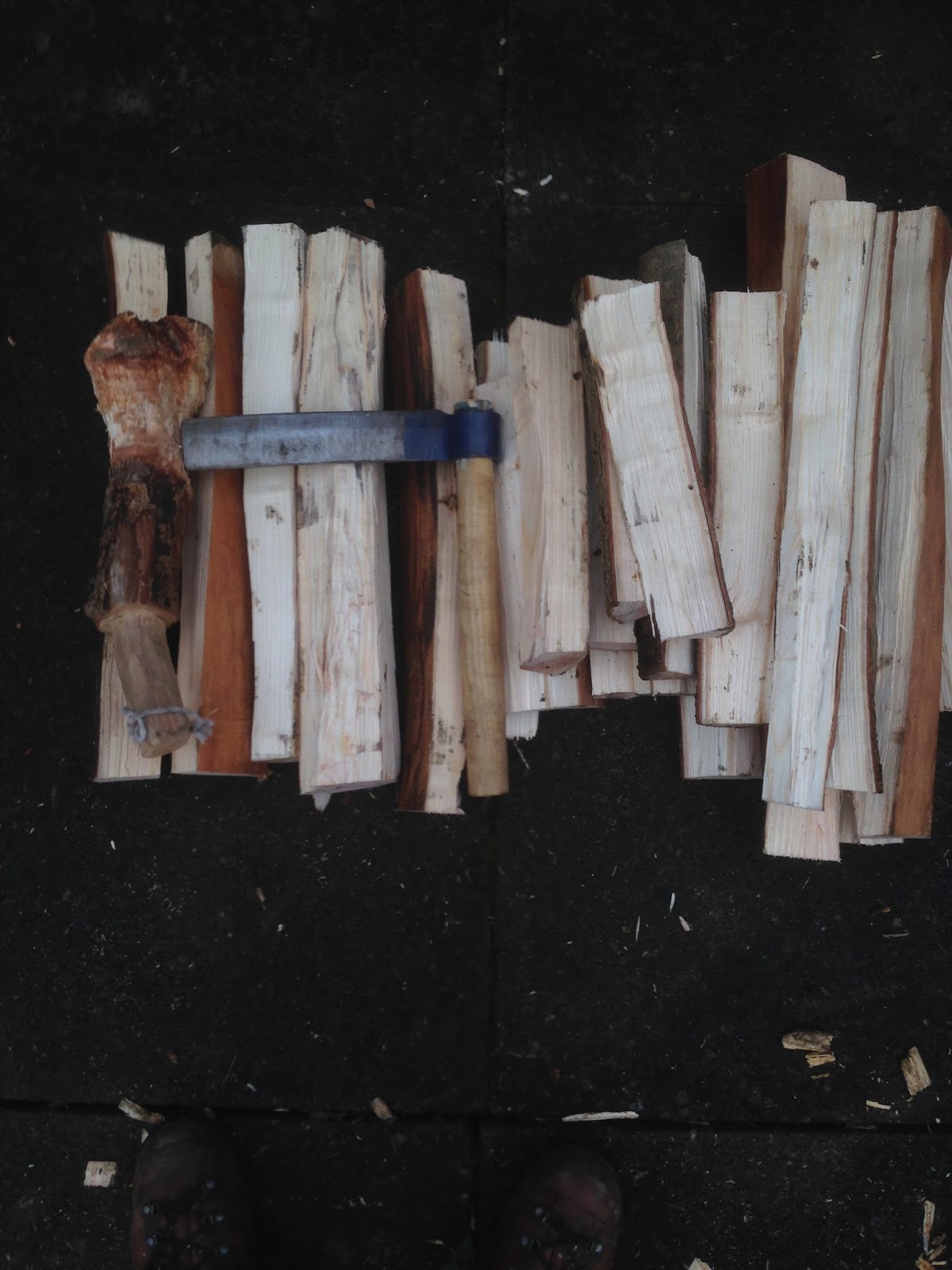
I’m currently preparing a course making post and rung stools inspired by Mike Abbott’s book Going With the Grain. These stools are delightful and a great introduction to riving and shaving green wood as well as greenwood joinery. I’m trying to condense it down to a one day course, but I think that might be a bit ambitious. One of the problems here is that the rungs would ideally be dried out overnight before doing the joinery. This means that the mortice in the, still green, legs will shrink slightly as they dry creating a very tight joint with the dried out tenons. If the rungs are not dry enough then the tenons will shrink too and the joint could become loose. I’m experimenting with drying the rungs out in the oven and hoping that the time it takes to make the legs (and to eat lunch) will be enough to bring the moisture content down sufficiently.
One of the things I love about this kind of stool is that you can get pleasing results with less than ideal wood. Most of my wood is salvaged/saved from the tree surgeons chipper. This means that more often than not it has been cut down from an urban setting where it wasn’t competing for light and is therefore not very straight. This can mean bendy grain and lots of knots, which is not really ideal for furniture making.
With this kind of stool it doesn’t really matter, in fact I think it adds to its charm. Wonky legs? Fine. Included knots? Not a problem. These are a great example of functional, user made furniture. Furniture of necessity.
These stools are currently being tested rigorously by my three boys. Sometimes they sit on them, but more often they are launch pads for their indoor acrobatics or construction elements for their dens. They are definitely proving to be functional, but they are also beautiful. Their imperfections make them lively and unique and remind us of the nature of natural materials.
Tuesday, 5 February 2019
Heavy Metal
Most people in the Green woodworking scene will be familiar with the work of Peter Follansbee. If you're not aware of Peter's work then stop reading this immediately and head over to Peter's blog, you won't regret it (but you might not come back here for a while).
![]() |
| Peter Follansbee's Side Axe |
Peter's side-axe is legendary. It's an important tool for his prep work and unfortunately 'they don't make 'em like they used to.' Peter regularly gets questions about his axe and he has produced this video to show some of the possible alternatives.
One day whilst trawling a popular online auction site I came across a vintage side-axe that looked like it might be perfect for this kind of work. It was going at a reasonable price, so I took a chance and bought it. When it arrived I quickly realised that I had made an error. The shape of the axe was perfect. The edge geometry was exactly what I was looking for. The problem was that it was huge. I had neglected to look at the weight of the axe on it's description. The heaviest axe that I use regularly is the Gransfors Swedish Carving axe which weighs 1kg. Peter's is a bit heavier at about 1.6, but this one weighs in at a whopping 2.3kg. This axe is HEAVY!
However all is not lost.
A few years ago I suffered from a bout of tennis elbow. Throwing an axe around all day can be quite a hard physical work out and I assumed that because I don't do this full time I had pushed myself too hard. That year whilst at Spoonfest I attended a talk by Terence McSweeney, green woodworker and professional Osteopath. One of the questions that was put to him was how to avoid tennis elbow (it seems that this was more common than I thought even among full time woodworkers). Terence's answer was that the problem was probably that their axes were too heavy (cue gasps from several affronted axe wielding spoon carvers). He explained that our bodies are not designed to work at full capacity for extended periods of time and therefore if we are using our heaviest axes all day, then our arms are under a lot of strain. What Terence suggested was that we build up our strength by sing a heavier axe for a short period and then when we return to or regular axe we are not working at full capacity.
So this has become my workout axe.
Ironically this axe used to belong to Terence McSweeney. If he was using it for similar purposes, then the axe that he has now worked up to must be a beast.
| Note how the back of the axe is slightly convex so that the edges don't bite into the wood |
Tuesday, 24 July 2018
Has it really been that long?
I knew I hadn't posted much recently - in fact that's understating it - I knew I hadn't posted anything for ages. And I knew I hadn't posted for ages because I haven't actually carved anything since the Countryside Show in Leicestershire last August!
When I went to look at the blog to see what was the last thing posted I thought "good, Julian has posted recently." It wasn't until I looked closer that I realised what I had thought said July 2018, was actually July 2017! We really are rubbish at this!
That's not to say I haven't done anything. I have done some black-smithing to make pattern forged steel and I have made several knives and a bit of leather-work, but I find I have less and less time on my hands for these activities and have decided I need to make a concerted effort to do more.
So, here is my first spoon in a year. It is not the spoon I intended to make, but my first effort split right down the middle - my recently split billets of 'green' wood have suffered the very warm weather we are enjoying and are as dry as match wood. Nonetheless, here is my day's effort.
It is one of my favourite spoon designs - I call it a coffee paddle. It is thin and delicate, with a subtle crank and just the thing for making and stirring hot drinks.
It is not all I did today. I had noticed on a walk recently along our local canal, that someone had done some work on the trees at one section, and left some rather large sections of what I am guessing is probably a willow of some kind.
The best of the pieces was too big and heavy to carry so I went out early this morning with the intention of splitting it into quarters or eights so I could bring some home, maybe to use as bench legs.
I set to with axe and wedges, only to find that the wood inside twisted so badly that it took me best part of an hour to do the first split (and retrieve my wedges which at one point were horribly trapped within the twisted fibers).
Looking at what I'd got, I figured this was potentially a lot of effort for what would no doubt end up as fire wood and so I cut my losses - it beat me, I admitted defeat. I really should have looked more closely at the position of the sap wood at either end of the log and would have worked out before I'd stared that it wasn't going to be straight. Oh well, I still get so excited over a length of free wood that I don't always think logically, and I'd like to say I've learned my lesson and will be more circumspect in future, but I know that's probably not true!
Now, let's hope I can actually remember how to post to the blog.
When I went to look at the blog to see what was the last thing posted I thought "good, Julian has posted recently." It wasn't until I looked closer that I realised what I had thought said July 2018, was actually July 2017! We really are rubbish at this!
That's not to say I haven't done anything. I have done some black-smithing to make pattern forged steel and I have made several knives and a bit of leather-work, but I find I have less and less time on my hands for these activities and have decided I need to make a concerted effort to do more.
So, here is my first spoon in a year. It is not the spoon I intended to make, but my first effort split right down the middle - my recently split billets of 'green' wood have suffered the very warm weather we are enjoying and are as dry as match wood. Nonetheless, here is my day's effort.
It is one of my favourite spoon designs - I call it a coffee paddle. It is thin and delicate, with a subtle crank and just the thing for making and stirring hot drinks.
It is not all I did today. I had noticed on a walk recently along our local canal, that someone had done some work on the trees at one section, and left some rather large sections of what I am guessing is probably a willow of some kind.
The best of the pieces was too big and heavy to carry so I went out early this morning with the intention of splitting it into quarters or eights so I could bring some home, maybe to use as bench legs.
I set to with axe and wedges, only to find that the wood inside twisted so badly that it took me best part of an hour to do the first split (and retrieve my wedges which at one point were horribly trapped within the twisted fibers).
Looking at what I'd got, I figured this was potentially a lot of effort for what would no doubt end up as fire wood and so I cut my losses - it beat me, I admitted defeat. I really should have looked more closely at the position of the sap wood at either end of the log and would have worked out before I'd stared that it wasn't going to be straight. Oh well, I still get so excited over a length of free wood that I don't always think logically, and I'd like to say I've learned my lesson and will be more circumspect in future, but I know that's probably not true!
Now, let's hope I can actually remember how to post to the blog.
Friday, 21 July 2017
Welsh Stick Chair
This is the most amazing chair in the world. Not because it is particularly nice to look at or because of its flawless construction, this chair is amazing because it exists. The fact that I actually managed to complete this chair is a miracle. There were several things working against me; firstly there is the problem of time. As a full-time History teacher with a young family it is sometimes difficult to find large blocks of time to do woodwork. This isn't so much of a problem when it comes to my usual work: bowl turning, spoon carving and other small projects that can be finished in an evening. It was much more difficult to keep momentum with the chair, especially as I was spending a few hours working and ending up with only a pile of sticks to show for it. There were also tools that I needed to acquire and sourcing the right materials too, but by far the biggest obstacle was the fact that I'm a bit of a chicken. Cautious is probably a better way of putting it. Whenever I try something new I like to read about it first, then I like to read something else about it and then, before I start I like to read about it. This was no exception, in fact the journey started with this post about several books that I'd been reading in preparation, that was two years nearly before the chair was finished and I included several other books in-between, in fact I could probably just pile up my chair-making books and sit on them.
| Some of the books I used to help me |
This turned out to be a much more difficult approach than I had anticipated as I didn't have a single measurement or angle to go by. I should have worked out one measurement and then scaled everything up, but I didn't, I just made it up as I went along.
So, in December 2015 work began when I went to a friend's house to split up some big oak that had been taken down in his back garden.
| Tools ready for action |
| Nick with the spoils of the day |
| Lovely slabs of green Oak |
One of the most enjoyable and frustrating elements was making the crest rail. This involved hewing and then planing a section flat and square, which I'd never really done before. Peter Follansbee's book on the joined stool was a big help here. Planing the green oak was one of the most satisfying things I've ever done. The smell was amazing.
Bending jig mark 1 (not long enough and not enough curve.
|
| A pile of sticks |
| Riding the shave horse |
| More shaving |
| Check out the footwear |
| This model made from MDF and coat hanger wire helped me to work out the angles of the legs. |
By May 2016 everything was ready except for the crest rail, which, as I mentioned previously, had to be remade for the fourth time.
Then Summer happened and the whole project was shelved until December, when Richard came round and we finished the project off together.
I was tempted to paint it like the one on the picture that I used for inspiration, but in the end I just finished it with Danish oil and a beeswax paste. We had a lot of people round for Christmas (17 for Christmas dinner) and so it got a lot of use and approval. The boys love it and will often argue over who gets to sit in Daddy's chair. If I speed things up a bit, I might be able to make them one each before they move out.
Wednesday, 12 July 2017
Spon
For some time, it seems, if you wanted to get into spoon carving, then there were only really two books that showed you how in any detail, and they were both out of print and hard to get on a sensible budget. The modern spoon maker/bibliophile is spoilt for choice, with no less than three books being released this year alone.
Spon, by Barn 'the spoon' Carder is the latest one to hit the shelves and it is a must for beginners and experts alike. If anyone is qualified to write a book about carving wooden spoons it is Mr The Spoon. Barn spent several years travelling the country, sleeping in the woods, carving spoons on the streets and peddling his wares. It was at this time that I first found out about him from Robin Wood's blog and contacted him offering him somewhere to stay, if he was ever in the area and fancied a rest from sleeping under the trees. It seems this offer may have frightened Barn as not long after this he moved to the city and took up residence in a traditional dwelling known as a house. Barn is co-founder of Spoonfest, the first international spoon carving festival, and he also opened his own shop in London that sold, guess what? That's right, hand carved wooden spoons. He even has his own Wikipedia page.
The book is well designed and beautiful, but has a raw, almost handmade feel due to the uncovered end boards. There are loads of full colour photographs to help teach and inspire. After an introduction that is romantic, but at the same time pragmatic as he extols the virtues of his craft, there are chapters on wood selection, tools and a step by step guide to carving your first spoon.
What I really love about this book though, is the second section which contains four chapters looking at sixteen different styles of spoon. Each spoon in this section has its own little essay on the design features and how to create them, as well as photos showing the spoon from three different angles. This is incredibly helpful for someone that is trying to improve their carving, seeking inspiration or trying to copy Barn's spoons and pass them off as originals.
Seriously though, I think that copying someone else's spoons is a great way of improving your own carving. Ideally you would have the actual spoon to copy, but this is the next best thing.
For those that want to take things even further, Barn is now creating videos of how to make the sixteen spoons in his book as well as other spoon making tutorials. He has already finished several of them and you can view them by subscribing through the Green Wood Guild.
You can purchase Barn's book here.
And subscribe to the videos here.
Monday, 3 July 2017
Forging an axe with Nic Westermann
| My finished axe head |
| The Main Man |
Last year Richard and I spent a day with Nic in his workshop forging axes under his expert guidance. I'd met Nic a couple of years previously at Spoonfest and he struck me then as being a very nice and down to earth kind of guy. He kindly offered to let us camp in his back garden the night before so that we could make an early start the next day, so we arrived at his house in Wales at about 5pm. Nic had warned me that I should probably bring some insect repellant as it can get a bit midgey this time of year, advice that I stupidly ignored. I've never really been a victim of insect bites, when those around me have suffered I've always emerged unscathed and felt somewhat smug as if being unattractive to biting insects was some kind of super power. However, I had obviously never encountered the particular breed of insect (which I can only describe as pure evil) that inhabits Nic Westermann's garden. After 10 minutes of struggling to put up a tent whilst performing the insect dance, we ran like a pair of teenage girls being pursued by a rabid mutant dog and took shelter in the car. Nic came to the rescue and kindly let us sleep in the back of his van, which was midge proof and very comfy (though I'm sure that if I strained my ears I could probably hear the sound of a thousand tiny collisions on the side of the van as the nasty beggars tried to break in).
| This is what we started with |
| Nic striking for Richard |
| and for me |
| Starting to punch the eye |
http://nicwestermann.co.uk
http://thegreenwoodguild.com
| Rich grinding the edge profile |
| The power hammer |
| Rich's axe (and his grubby hands) |
| Rich's axe with handle |
| Mine with handle |
Subscribe to:
Posts (Atom)