Saturday, 3 January 2015
New Years Turning
I turned this pair of bowls over the last couple of days using the final Birch log of a few I managed to score at the Elvaston Woodland Festival. The second of the two ended up with three knots in the rim that weren't apparent on the blank.
As soon as I saw them I anticipated that they would cause the bowl to crack, but when I looked at it this morning I was surprised to see that it had cracked on the end grain instead.
This may have been my fault as I didn't bother to submerge it in wet shavings for a while, which is what I usually do. The reason that I didn't use the wet shavings trick is that the last time I did, with bowls from the same tree, it ended up showing a bit of mould. It could just be one of those things, but I can't help feeling a bit responsible for this one.
Friday, 2 January 2015
Carving with my brothers
| Richard's lightning fast axe work |
| Eden taking things slowly |
| Our collection of spoons |
| Richard's customised Mora 106 |
| A wooden case for Richard's Robin Wood spoon knife |
Thursday, 1 January 2015
Robin Wood Carving Axe
I've noticed a few people asking about this axe recently on the green woodworking forums, so I thought it was about time I wrote a little review. I should probably start with a bit of background on the axe. If you don't already know about Robin Wood, then you should. He is one of the leading figures in green woodworking and traditional crafts in the UK. Primarily he is a bowl turner, but he has also been influential in the popularisation of spoon carving. For three years he has been the co-organiser of Spoonfest. When running spoon carving courses he lamented the fact that he couldn't recommend a suitable axe to his students that was the right side of fifty pounds. Probably the cheapest option at the time that would be ready to use off the shelf was the Gransfors Bruks Wildlife hatchet, which currently retails at about £65, a big outlay for someone who is just beginning. This led to him designing and manufacturing his own carving axe.
| The axe comes incredibly sharp, but unfortunately doesn't come with a mask |
At 500g in weight it is perfect for spoon carving, especially for those who aren't used to wielding an axe or don't do it that often. The light weight also means that you can be very precise with it. When I first tested it out I started carving a spoon out of some relatively hard apple. I ended up carving the entire spoon (except the bowl) using just the axe. It's not the prettiest spoon I've ever made, but it does show what you can do with a well tuned axe.
| A pretty ugly spoon, but all done with the axe |
The edge comes very sharp with a flat bevel that is polished to a mirror finish. It bites really well and the head can be held in the hand to make planing or knife cuts.
The handle is made of Hickory and has a lovely textured finish, similar to that found on the tools made by Svante Djarv, the idea being that it provides extra grip. I've personally never had a problem with a non-textured handle being slippy, but it definitely looks cooler like this.
| Textured handle |
| The Svante Djarv Little Viking axe with similar textured handle |
| Similar shaped head from a Car boot sale |
You can buy the axe directly from Robin Wood or from Woodland Craft Supplies.
Wednesday, 31 December 2014
One that got away....
I'd meant to include this spoon in my last post but forgot.
It's nothing special - a birch serving spoon - but there is something about it I love.
As you can see, it's not carved from regular green birch, which is generally quite blonde wood, but from a piece of spalted birch. Spalting is an effect caused, usually in dead wood (though not always) by the colonization of fungi which causes irregular colour changes and patternation of the timber. It can cause weakness in the wood but, as you can see from the zoning lines and colours of the spoon, it's worth making the effort with in order to get something a little different.
This spoon was particularly hard to carve as in places it was a bit punky and brittle - the thing I can best compare it to are those white firelighter blocks that snap and crumble.
What I love most about the spoon is how parts of it - the bits that are a toffee kind of colour - go completely translucent when held up to light - it's as if the wood has begun to turn to amber.
You can see the translucence a little on the bowl and handle - you can get the same effect by carving the spoon thinly, but this is actually quite a chunky spoon, but still quite see-through.
It's nothing special - a birch serving spoon - but there is something about it I love.
As you can see, it's not carved from regular green birch, which is generally quite blonde wood, but from a piece of spalted birch. Spalting is an effect caused, usually in dead wood (though not always) by the colonization of fungi which causes irregular colour changes and patternation of the timber. It can cause weakness in the wood but, as you can see from the zoning lines and colours of the spoon, it's worth making the effort with in order to get something a little different.
This spoon was particularly hard to carve as in places it was a bit punky and brittle - the thing I can best compare it to are those white firelighter blocks that snap and crumble.
What I love most about the spoon is how parts of it - the bits that are a toffee kind of colour - go completely translucent when held up to light - it's as if the wood has begun to turn to amber.
You can see the translucence a little on the bowl and handle - you can get the same effect by carving the spoon thinly, but this is actually quite a chunky spoon, but still quite see-through.
Some Christmas carving...
It's been a really busy school term and I haven't really had too much time for carving, so I was glad when we broke up for Christmas and I was able to dabble a little. I have to admit, I'm a little bit rusty, so it was particularly good to remind myself just how much I enjoy carving.
I came home one day to discover a friend from my last school had dropped round a bag with some sections of yew in - not a wood I get much opportunity to carve. There was one piece that was a natural spoon crook and so I thought it might make a nice gift to say thanks for the wood.
It was enjoyable to carve, not too hard or fibrous, and I just love the stark contrast between the dark heartwood and the light sap wood. I don't generally sand my spoons but I couldn't resist with this one and the dark grain came up like a horse chestnut.
| The pattern on the handle is in two parts - the darker lines are carved (a thin sliver of wood removed) whilst the lighter lines are kolrossed or scored. |
| I just love that rich grain pattern. |
I've mentioned many times before how I prefer the aesthetics of a cranked, or curved, spoon.....
....but this one went a little too far, I think. It works a bit more like a shovel than a spoon - good for a croupier maybe?
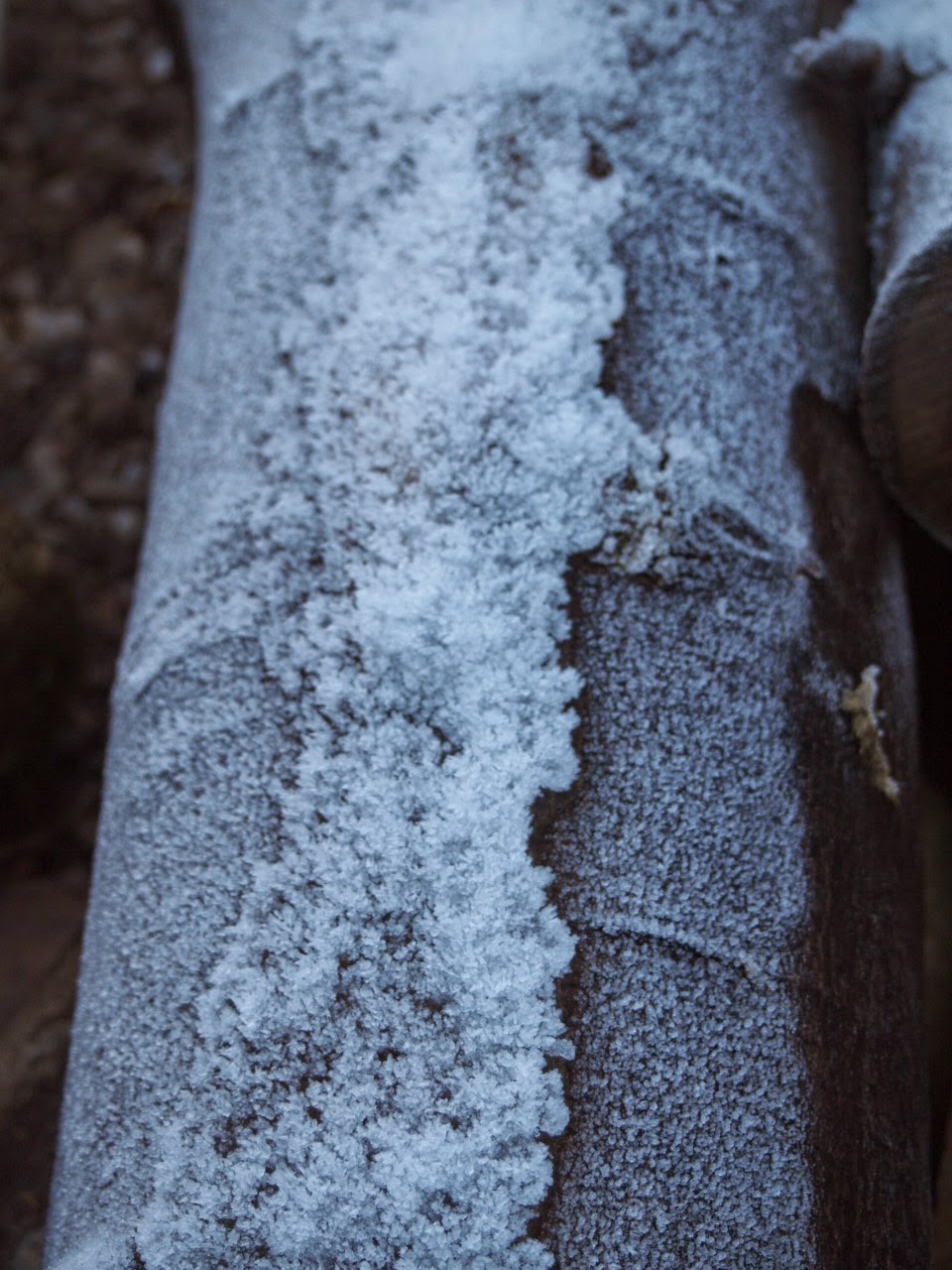
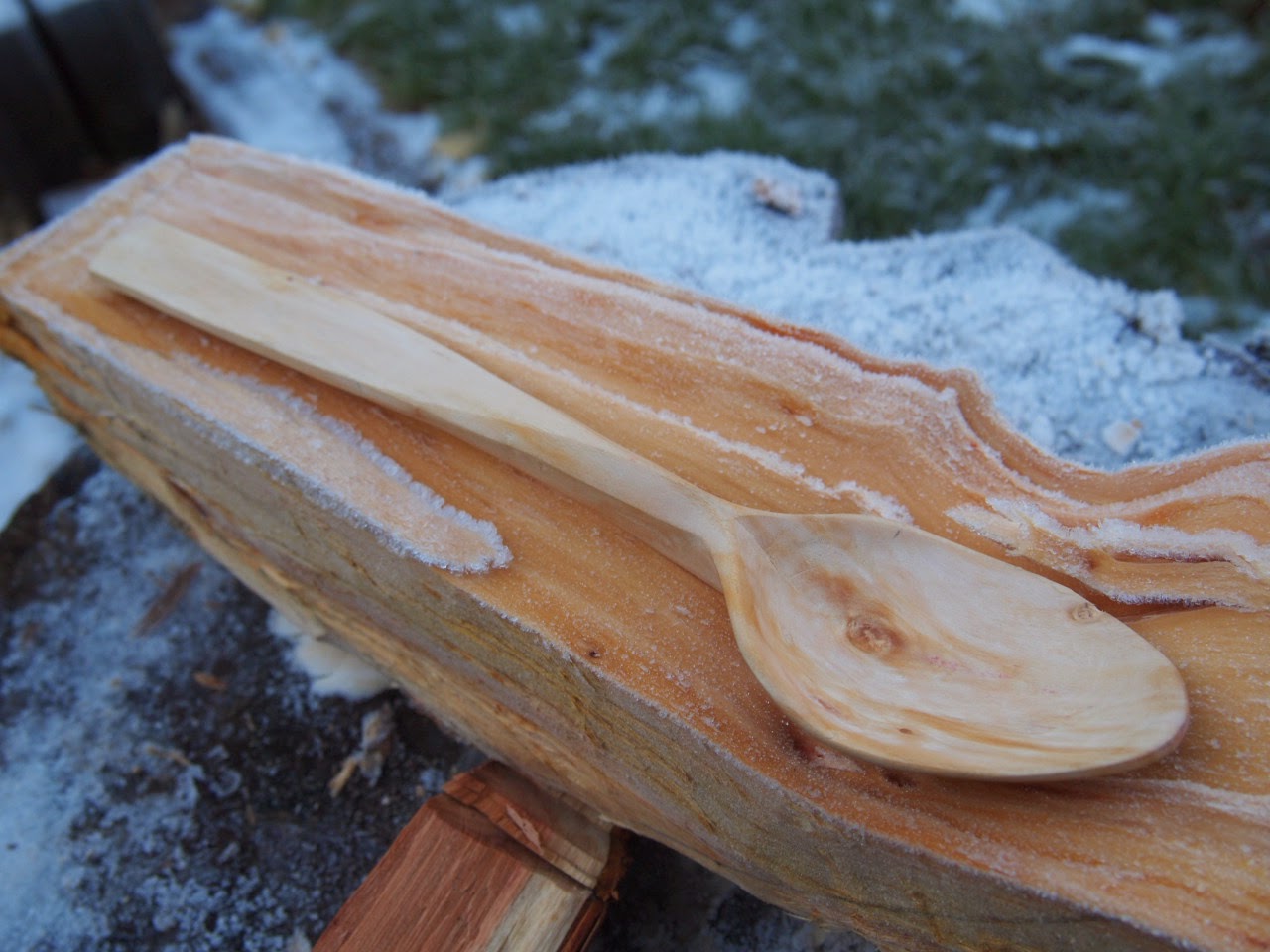
On Monday two of my brothers, Ju and Eden, came over and we did some carving together. It was frosty outside, the wood pile was crusted with ice....
...and I had to defrost my chopping block with a kettle of boiling water as I was afraid the ice would chip the edge of my axe.
I'm not going to say too much about our day as Ju took photos so I'm expecting he will post. Ju brought a huge block of willow with him - He'd intended to turn a bowl from it but noticed a knot so thought it would be better billeted for spoons. We split it and there were knots and swirls all through the grain, so not really ideal at all. One piece, however, seemed to lend itself to carving into a spoon, so I thought i'd give it a go.
| I probably shouldn't have risked it, with all the knots and crazy grain. |
| The crank of the bowl follows the grain of the wood. |
A crazy knot in the middle of the bowl, but with a razor sharp knife and some very careful carving and it all turned out ok.
Sunday, 23 November 2014
Spooncarving Course
It's been a while since I posted on here, so I thought I'd put some pics up of a spoon carving course we did recently. I'm not sure who the first person to say this was (I think it might have been Barn Carder), but I've heard someone refer to spoon carving as the gateway drug of greenwood working. That's certainly how it was for me and it's exciting to think that we're introducing people to this kind of thing.
Our students for the day were David and Jane, a great couple that picked things up very quickly. It was particularly satisfying watching them gain confidence with the axe as they were both a little bit cautious at first (understandably).
The weather was terrible so we took over Richard's kitchen for the day. This meant that we could smell the lovely sausage and lentil lunch that Richard had made for us mixed in with the smell of the green wood.
Jane is an illustrator and has recently been working on a couple of books by Ben Law. I loved the drawings that she made to accompany her notes.
Time flew by and it was a bit of a rush towards the end, but they both managed to finish their spoons and also took some wood with them to complete the set.
| Dave getting used to the axe |
| Richard helping Jane with some of the knife grasps |
| Pointing out some of the elements of spoon design |
Wednesday, 5 November 2014
A day of carving contrasts.....
I haven't really done much carving over the past few months - any of you who work in schools will understand, that first half-term back is pretty hectic and so when I've had the time, I haven't really had the energy.
During the half term holidays I went with my wife and two youngest to Prestatyn, North Wales for 5 days in a caravan at a Haven Holidays camp site. It's not something we've ever done before, but it was one of those holidays vouchers-in-The Sun-for-£9-which-once-you've-added-all-the-non optional-extras-actually-costs-you-considerably-more type holidays so we thought we'd give it a try as we had very little to loose. To cut a long story short, whilst I had a blast being with my family, playing Boggle, learning to play Backgammon and eating Reeses Pieces which were only a pound a packet at the Poundshop, it wasn't really our cup of tea and I can't see us doing a holiday camp type holiday again.....but.....
Whilst I am not a fan of storms so powerful they do damage and endanger lives, the silver lining to such events for the greenwood carver is the bounty of wood we can sometimes pick up as a by-product. When hurricane Gonzalo came a-calling on the Monday night of our stay in Prestatyn, I awoke to the sound, irresistible to all carvers, of a chainsaw working near by.
I jumped up, dressed and went out to find that a willow tree, one of the many scattered around the site, had been dislodged, its roots cracking a water main in the process, and the guys responsible for maintenance around the place were taking it down in order to stop the gushing.
When I asked if there was any chance of snagging a few pieces of wood (I couldn't take too much as my wife was insisting we take the children back home with us again) a very pleasant man named Josh (he of the chainsaw in the picture) said he would be happy to give me some wood and to come back in the morning when they had had time to mend the water issue and he would be cutting up the tree.
We chatted for a while and it turned out that Josh was himself a greenwood worker, making adzed bowls and some spoons and that he was a friend of Nic Westermann's and often struck for him when he was demonstrating. What a small world! We talked tools and wood for a while, before he needed to get back to work, but when I came back in the morning, not only had he set me aside some good sections of straight-grained wood, but had brought with him from home a green Hornbeam crook to have a go at carving. What a nice man!
So I came home with good memories and some wood - what could be better?
So, last weekend I sat down to rough out a few spoons and what a day of contrasts it turned out to be: on the one hand I had the Hornbeam - hard, close-grained, smooth as alabaster when you carve it but liberal with the blisters and leaving your knife in need of regular stropping; and on the other I had some spalted birch, almost on the turn and definitely past its best, fairly punky, soft as butter though more likely to 'snap-out' than shave but with a beautiful stripy patternation. And so I made myself a couple of spoons.
I'm looking forward to putting decoration of some sort on the Hornbeam as it should carve very crisply - perhaps some lettering.
During the half term holidays I went with my wife and two youngest to Prestatyn, North Wales for 5 days in a caravan at a Haven Holidays camp site. It's not something we've ever done before, but it was one of those holidays vouchers-in-The Sun-for-£9-which-once-you've-added-all-the-non optional-extras-actually-costs-you-considerably-more type holidays so we thought we'd give it a try as we had very little to loose. To cut a long story short, whilst I had a blast being with my family, playing Boggle, learning to play Backgammon and eating Reeses Pieces which were only a pound a packet at the Poundshop, it wasn't really our cup of tea and I can't see us doing a holiday camp type holiday again.....but.....
Whilst I am not a fan of storms so powerful they do damage and endanger lives, the silver lining to such events for the greenwood carver is the bounty of wood we can sometimes pick up as a by-product. When hurricane Gonzalo came a-calling on the Monday night of our stay in Prestatyn, I awoke to the sound, irresistible to all carvers, of a chainsaw working near by.
I jumped up, dressed and went out to find that a willow tree, one of the many scattered around the site, had been dislodged, its roots cracking a water main in the process, and the guys responsible for maintenance around the place were taking it down in order to stop the gushing.
When I asked if there was any chance of snagging a few pieces of wood (I couldn't take too much as my wife was insisting we take the children back home with us again) a very pleasant man named Josh (he of the chainsaw in the picture) said he would be happy to give me some wood and to come back in the morning when they had had time to mend the water issue and he would be cutting up the tree.
We chatted for a while and it turned out that Josh was himself a greenwood worker, making adzed bowls and some spoons and that he was a friend of Nic Westermann's and often struck for him when he was demonstrating. What a small world! We talked tools and wood for a while, before he needed to get back to work, but when I came back in the morning, not only had he set me aside some good sections of straight-grained wood, but had brought with him from home a green Hornbeam crook to have a go at carving. What a nice man!
So I came home with good memories and some wood - what could be better?
So, last weekend I sat down to rough out a few spoons and what a day of contrasts it turned out to be: on the one hand I had the Hornbeam - hard, close-grained, smooth as alabaster when you carve it but liberal with the blisters and leaving your knife in need of regular stropping; and on the other I had some spalted birch, almost on the turn and definitely past its best, fairly punky, soft as butter though more likely to 'snap-out' than shave but with a beautiful stripy patternation. And so I made myself a couple of spoons.
I'm looking forward to putting decoration of some sort on the Hornbeam as it should carve very crisply - perhaps some lettering.
| spoons in various stage of incompletion - work for another day |
Subscribe to:
Posts (Atom)